News & Stories
News & Stories Filtered BY
Filtered by
Global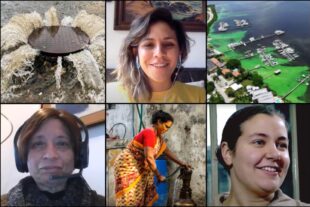
2020 MIT Water Summit brings international audiences together to discuss resilience
Earlier this semester, the MIT student group The Water Club gathered to discuss topics for their eighth annual MIT Water Summit. Given the dramatic challenges of 2020, the group knew this year’s decision was particularly weighty. Commenting on the process, Laura Chen, a junior in chemical engineering and director of the 2020 Water Summit, recalled, […]
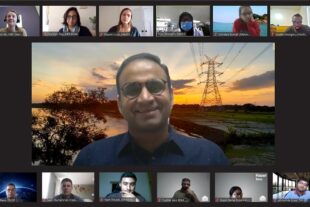
MISTI pilots conversations in energy
While fall typically sees MIT International Science and Technology Initiatives (MISTI) programs gearing up to facilitate international summer internship and research experiences for MIT students, this year’s changing global circumstances presented challenges to making in-country internships happen — but they also offered new opportunities for students to engage with organizations and leaders overseas. Combining MISTI’s […]
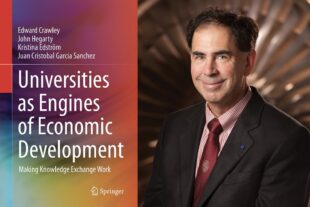
Shaping universities to be engines of economic development
Universities perform best as engines of economic development when they systematically exchange knowledge with their partners in industry and government, according to a new book co-authored by an MIT professor and former university president. At the moment, this “exchange” too often operates like a one-way street, the authors write, with universities sending graduates and research […]

Report outlines route toward better jobs, wider prosperity
Decades of technological change have polarized the earnings of the American workforce, helping highly educated white-collar workers thrive, while hollowing out the middle class. Yet present-day advances like robots and artificial intelligence do not spell doom for middle-tier or lower-wage workers, since innovations create jobs as well. With better policies in place, more people could […]
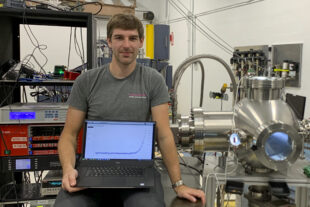
Pushing the envelope with fusion magnets
“At the age of between 12 and 15 I was drawing; I was making plans of fusion devices.” David Fischer remembers growing up in Vienna, Austria, imagining how best to cool the furnace used to contain the hot soup of ions known as plasma in a fusion device called a tokamak. With plasma hotter than […]

A global collaboration to move artificial intelligence principles to practice
Today, artificial intelligence — and the computing systems that underlie it — are more than just matters of technology; they are matters of state and society, of governance and the public interest. The choices that technologists, policymakers, and communities make in the next few years will shape the relationship between machines and humans for decades to […]
Learning by doing, remotely
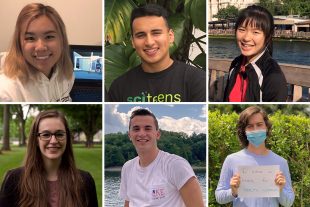
Experiential learning is alive and well at MIT — even when it’s remote. Just ask Julian Zulueta, a sophomore in biological engineering. Last May, he spotted an intriguing social impact internship opportunity in the PKG Public Service Center newsletter: The CDC Foundation, a Congressionally-chartered nonprofit created to support the Centers for Disease Control and Prevention […]
Diverse international cohort first to earn MIT master’s degrees in data, economics, and development policy
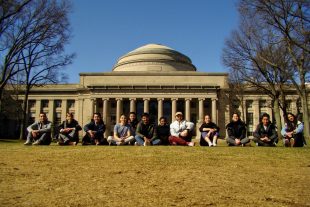
This past January, 22 students from across the world joined the MIT campus as the first cohort in the new MIT master’s program in Data, Economics, and Development Policy (DEDP). Developed by MIT’s Department of Economics and the Abdul Latif Jameel Poverty Action Lab (J-PAL), the program represents a new approach to higher education by […]

Technique could enable cheaper fertilizer production
Most of the world’s fertilizer is produced in large manufacturing plants, which require huge amounts of energy to generate the high temperatures and pressures needed to combine nitrogen and hydrogen into ammonia. MIT chemical engineers are working to develop a smaller-scale alternative, which they envision could be used to locally produce fertilizer for farmers in […]

Engineers develop precision injection system for plants
While the human world is reeling from one pandemic, there are several ongoing epidemics that affect crops and put global food production at risk. Oranges, olives, and bananas are already under threat in many areas due to diseases that affect plants’ circulatory systems and that cannot be treated by applying pesticides. A new method developed […]