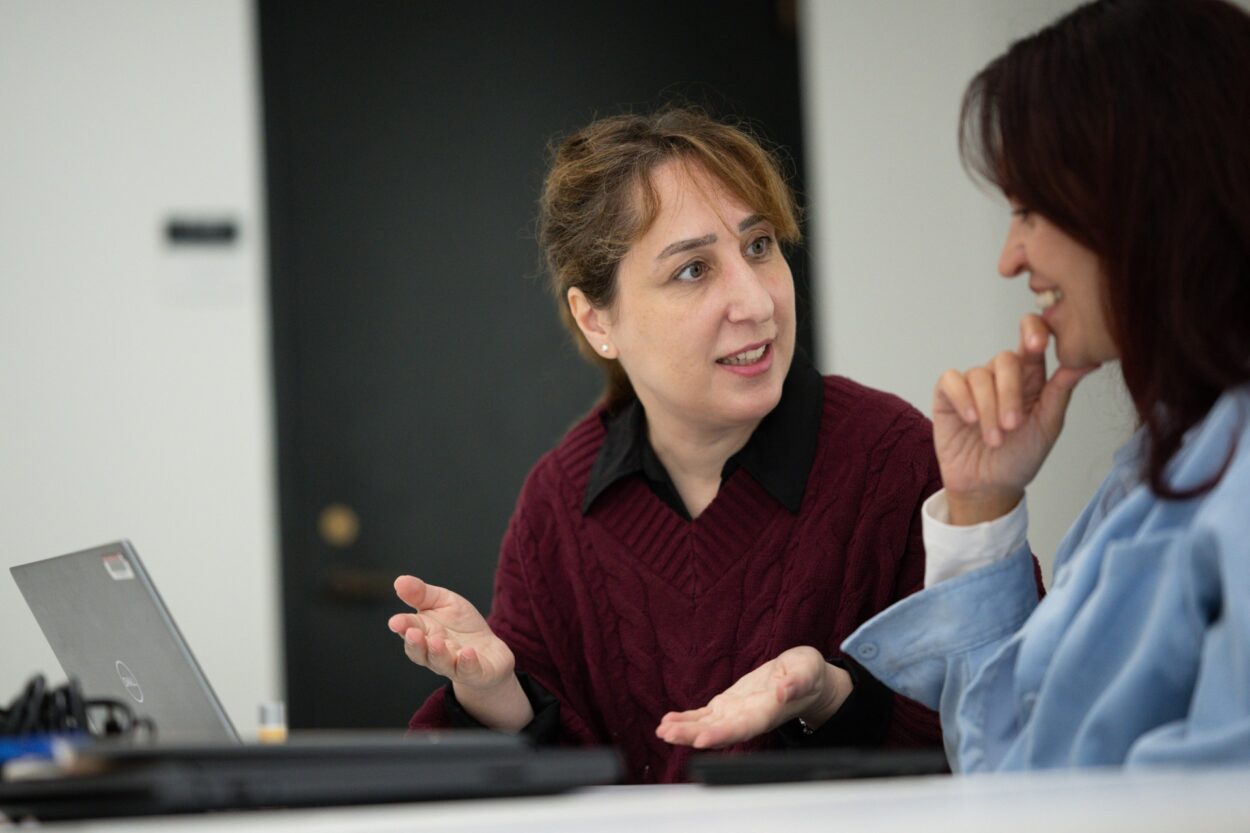
Shireen Bader Alqadi, MIT’s first Global MIT At-Risk Fellow (GMAF) from Palestine, reflects on spending the Fall 2025 semester in the MIT’s Sustainable Design Lab with Architecture Professor Christoph Reinhart and team.
Global MIT At-Risk Fellows (GMAF) brings international scholars to MIT for semester-long study and research meant to benefit their regions of origin while simultaneously enriching the MIT community. Building on the original iteration of the program, GMAF Ukraine, GMAF Palestine was launched in 2024 as a two-year pilot for early- to mid-career Palestinian scholars, currently either living in Palestine or recently displaced, to continue their work during a semester at MIT. The GMAF Palestine faculty committee is working to expand opportunities beyond the 10 pilot fellows.
Shireen Bader Alqadi, an architecture professor at Birzeit University in the West Bank, spent her semester at MIT working to absorb as many new ideas as possible. She says she paid special attention to MIT’s research culture and best practices to inform her teaching and research with students in Palestine. While at MIT, her research focus has been on developing guidelines for sustainable rebuilding in Gaza.
1. Tell me a little about yourself and what has stood out to you during your time at MIT?
As an architect, my passion is to help provide living and working spaces for people that are both comfortable and sustainable; from a cost perspective and for our planet. At home in Palestine, we have both cold and wet winters and hot and dry summers. Because the temperature can be so uncomfortable it’s really satisfying when I get to see how much a well-designed building is improving people’s lives.
I originally got into architecture because I’ve always liked art as well as science. My parents had scientific backgrounds, and I always cared about the environment. Now in my work I get to bring together, art, science and environment in sustainable architecture.
It’s probably because of my love of both art and science that the multi-disciplinary aspects of MIT and the fluidity of the way people can collaborate without walls has stood out to me the most. These types of deep synergies between disciplines are something I hope can be implemented in Palestinian universities. I plan to share examples of the interdisciplinary approach I experienced at MIT to inspire with my students when I return home.
Another thing I found transformative about working with the MIT research community is that it’s not just about publications. It’s about impact and how to create a better world. I’ve found it very compelling to work with people where all these ideas are brought together to make the world a better place for everyone. I had the chance to see this in action from my first week at MIT attending events like MIT’s delta v Demo Day and MIT Energy Initiative (MITEI) workshops with its unique model of bringing education, research and industry together. Every time I saw how the different entities at MIT work in harmony, I got new ideas for applying these ideas in my own work
2. Can you describe your experiences working in the Sustainable Design Lab and developing guidelines for sustainable building?
The thing I’ll miss most is the weekly presentations, discussions, and mind mapping with Prof. Christoph Reinhart, the Sustainable Design Lab (SDL), and The Building Technology (BT) Program. There was so much room for collaborative conversations and brainstorming. For my own research, I received input from everyone in the lab. Whether they had big or small ideas, they have all been so valuable. Being part of these of conversations, you get the feeling that it’s everyone’s responsibility to make things better.
It has also been so amazing to use tools like ClimateStudio that have been developed in the SDL and are now used all over the world for improving the environmental performance of buildings. I have learned so much from using the tool itself and seeing how it grew out of a lab with physicists, engineers and designers working together.
With collaborative support of the lab community, I developed a framework for the reconstruction of the housing sector with sustainability guidelines for rebuilding in Gaza. We developed various configurations for basic housing units taking into account factors like the comfort of the occupants, resilience, future climate scenarios, and available resources. For example, we gave guidelines on safely reusing rubble from destroyed buildings and compared the different available solutions for enhancing energy security and wellbeing. One of the research outcomes is a toolkit of design blueprints for sustainable climate proof housing, that can be used by the residents and by international bodies involved in the reconstruction. We also plan to publish a whitepaper soon to make the framework accessible.
3. What has your experience been being part of GMAF Palestine and what are your plans for when you return home?
I felt an amazing amount of support and very welcomed at MIT. At the same time being there highlighted how isolated I am in Palestine from the broader academic community and how hard it is to keep up with new ideas and technologies. It’s been tremendously valuable to have the chance to reconnect with the global academic community through MIT.
Returning home, I have a lot of new plans for sustainability work in my community and hopefully inspiring my students to join me. One of the aspects of lab culture I want to incorporate more is the culture of trying to bring the best out of every person working on a project and encouraging multidisciplinary research. I’ve seen how great it is being a part of a group of people who care about your output because it’s shared as a lab. I met so many inspiring people at MIT and some of them have already agreed to give some special guest lectures to my classes this spring.
Longer term, I hope to utilize the knowledge and tools I learned at the MIT to develop new models and frameworks for creating sustainable built environments in Palestine. This includes supporting the local community through more energy efficient and resilient buildings. I plan to adapt my framework with recommendations for sustainable public buildings in the West Bank, especially in buildings for people with special needs like hospitals and schools for kids who are amputees. Additionally, I’ve always been interested in entrepreneurship. Seeing researchers around me at MIT bring their helpful ideas to people through business has given me new and practical tools to take that on as well.
Spending a semester at MIT is a major milestone in my career, as it opened my eyes to new possibilities, expanded my network and given me the opportunity to engage with global experts. I would like to thank MIT and GMAF Palestine for this valuable opportunity.
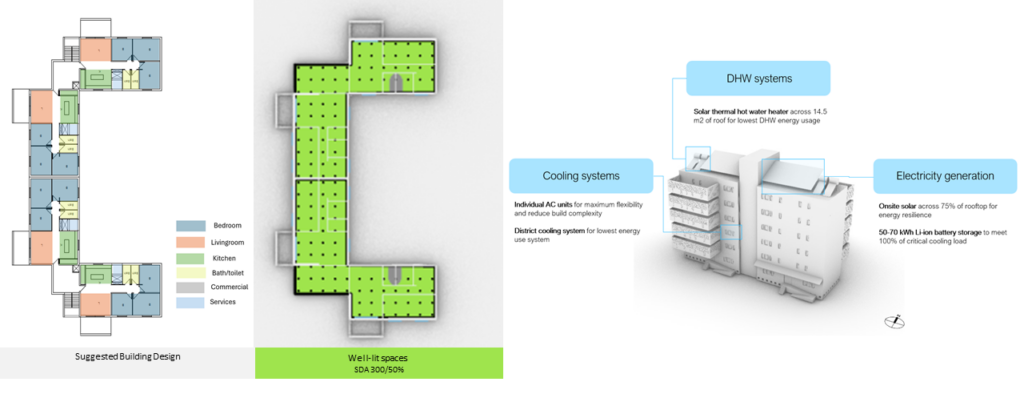
Photo: Shireen Bader Alqadi