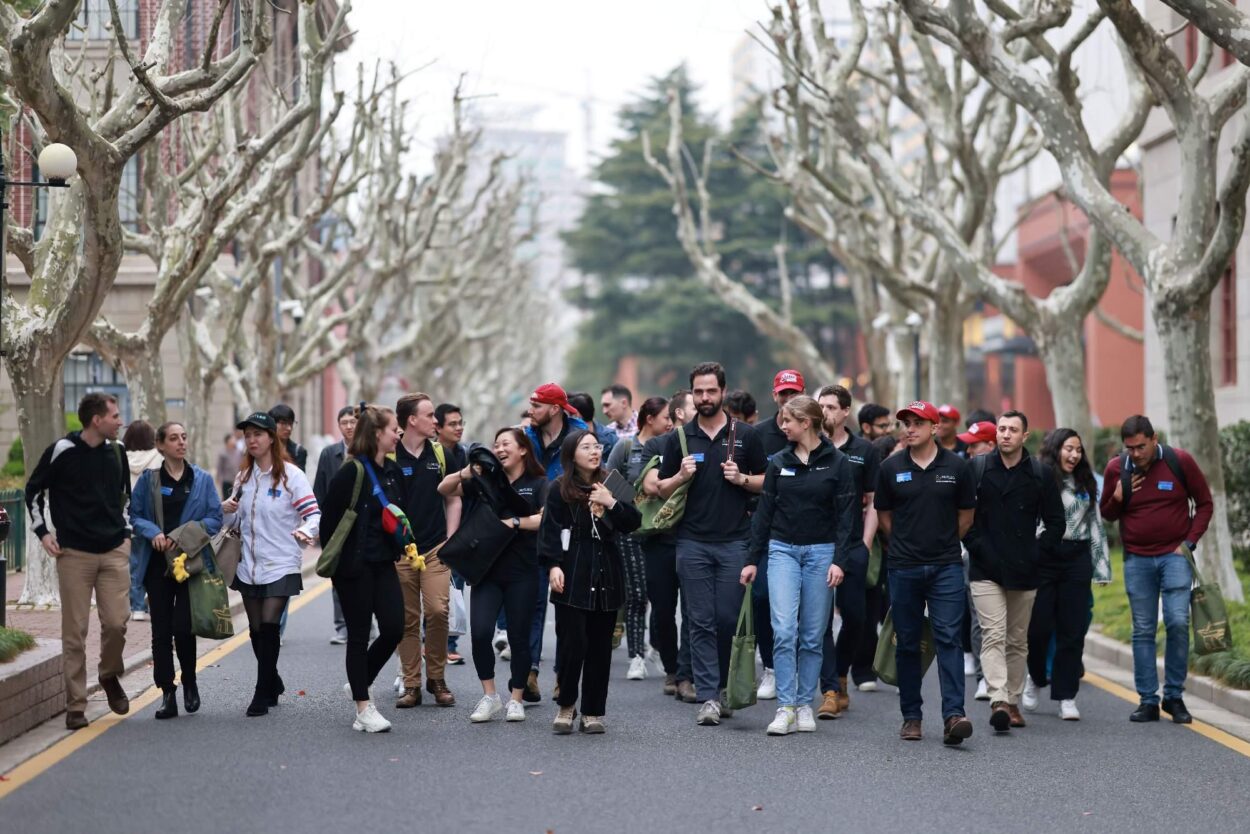
Twenty-years ago, with guidance from faculty at MIT, Shanghai Jiao Tong University (SJTU) launched its China Leaders for Global Operations, a graduate program modeled after the Institute’s own longstanding Leaders for Global Operations. Integrating management and engineering, the CLGO program in Shanghai, which is managed and operated by SJTU, mirrors the academic design and execution of MIT’s LGO program, where students participate in courses relevant to manufacturing and operations fields like product design, supply chains and analytics.
For students enrolled in MIT’s 37-year-old LGO program, the collaboration with SJTU provides several unique benefits – from engagement with leading Chinese companies and experience with a different culture in business and personal settings, to connections with peers that can have long-lasting benefits for their careers.
The collaboration’s ability to deliver those distinct benefits to MIT students informed Institute leaders’ decision to extend the established program in 2024 through the end of 2027. While the LGO and CLGO programs are run independently by their home institutions, the decades-long connections between the two enable students in both programs to meet and learn from peers and industry operations in their respective countries.
“The LGO program – and its long-standing connection with the China LGO program in particular – offers a model for the kind of international activities that benefit student learning and success at both institutions, in my view,” says Duane Boning, vice provost for international activities at MIT. “These are ties that can endure even as international and political winds beyond our campuses may shift.”
Graduates of MIT’s Leaders for Global Operations earn two degrees at the end of their studies: an MBA from the Sloan School of Management and a Master of Science in one of eight engineering disciplines. Similarly, CLGO graduates at SJTU receive training in both business and engineering fields and earn an integrated degree. SJTU students who successfully complete their program also receive a certificate from the MIT LGO program, which provides academic support and manages week-long summer visits to MIT during which Chinese students visit Boston-area companies and experience local culture.
“The China LGO program strengthens many of our MIT students’ academic experiences by giving them firsthand exposure to global engineering and operations,” says Institute Professor Paula Hammond, dean of MIT’s school of engineering. “That kind of perspective is essential for preparing engineers to lead complex systems and solve challenges across industries.”
MIT LGO’s collaboration with the program in Shanghai doesn’t involve research. Nor is it a student exchange program in the traditional sense. Rather, it’s focused on honing the best educational practices through coursework and projects designed to provide students with the knowledge, skills and strategies needed for excellence in industrial operations worldwide.
Despite shifts in the international and political landscape, the program connections and curricular collaborations between MIT and SJTU have continued to thrive – a testament to its value to students in both hemispheres.
Richard M. Locke, John C Head III Dean at the MIT Sloan School of Management, says he considers MIT’s LGO program “one of the crown jewels of MIT Sloan because of the way it brings together technical and managerial education, combined with hands-on learning, to prepare future leaders to make an impact in industry.”
“China LGO, our sister program, gives students an additional lens on global business and provides opportunities for the exchange of valuable ideas, skills, and perspectives,” Locke adds,
In a statement supporting MIT’s most recent extension of the collaboration, Fangruo Chen, Dean of SJTU’s Antai College of Economics and Management, called the program “a beacon of educational innovation, crucial for cultivating leaders who can adeptly navigate the complexities of our interconnected, industrial economies.”
“This program exemplifies our shared dedication to nurturing talent with a global perspective, transcending the barriers of distance and adversity” he said.
Distinct benefits in an evolving landscape
While CLGO’s 20th anniversary coincides with changes in US-China industrial relations, MIT students and alumni remain convinced of its value. They report appreciating the collaborative program not only for deepening their understanding of the country’s importance in the context of US and international business interests, but also for opportunities like the biannual International Plant Trek trip, where students visit manufacturing and operations industry partner sites.
“What I believe was most important to MIT leadership was the sense that this continued relationship is really providing unique value to MIT students in our program,” MIT LGO Co-Director Joshua Jacobs said in a recent interview about the extension.
Emily Kehne, a 2019 MIT LGO alumna, says she’ll always remember a Chinese friend whom she met on her Trek air-shipping her 200 face masks during the first weeks of the Covid pandemic after she mentioned masks were in scarce supply in the US.
Beyond making personal connections, Kehne noted that “the relationship between the US and China, the world’s top two largest economies, has massive implications for geopolitics and will continue to be relevant in all aspects of business for the foreseeable future. Understanding the complexities of this relationship should be a fundamental aspect of educating future business leaders, particularly in the manufacturing industry.”
“For the US to stay competitive, it is imperative that future leaders and our faculty gain firsthand experiences in China,” added LGO Executive Director Thomas Roemer, noting that, “by having joint classroom sessions in China, our students start to understand the constraints of working in China.”
“Perhaps particularly in times of geopolitical tension,” Jacobs added, “this program offers American students who are going to be leaders in industry a unique chance to form authentic relationships with their peers in China and to get in-person insights about conditions in China, which is going to be an important part of their careers in operations.”